Why “predicting evolution” isn’t just forecasting cases
You can often forecast next month’s cases from this month’s cases because transmission follows near-term momentum: mobility, immunity, seasonality, and reporting delays. Predicting evolution is different. You’re not asking “how much spread,” but “which genetic changes will win,” and that depends on competition among many variants, chance events, and shifting constraints inside hosts and across populations.
A model can be excellent at spotting patterns in past sequences and still miss what matters operationally: whether a mutation improves replication, evades immunity, preserves viral stability, and remains compatible with other mutations. Even if it gets the “right” mutation, timing and impact may be wrong without knowing where it will arise, how quickly it will spread, and what immune landscape it will face.
The pattern-recognition trap: correlations that won’t generalize

In practice, many impressive sequence models are doing a refined version of autocomplete: they learn which mutations tended to appear together in the training set and assign higher scores to similar combinations. That can look like “foresight” when tomorrow resembles yesterday, but it breaks when the virus enters a new immune landscape or a new host population and the old co-occurrence rules stop applying. A classic failure mode is mistaking a hitchhiker for a driver—crediting a mutation that rode along with a successful lineage rather than one that caused the success.
Shortcuts creep in quietly. If most training genomes come from a few countries, time windows, or surveillance programs, the model can learn sampling artifacts: lab pipelines, founder effects, or which lineages were simply looked for more. Those cues can yield high retrospective accuracy while giving brittle forward predictions, especially when a rare but consequential mutation first appears in undersampled settings.
Data reality check: biased genomes, missing context
Picture a typical training dataset: millions of genomes, neatly aligned, time-stamped, and ready for modeling. What’s less visible is how uneven that pile is. Sequencing surges during waves, clusters around major cities and well-funded labs, and often focuses on cases that are easier to sample or more likely to be investigated. A model can mistake that surveillance footprint for biology, confidently “predicting” what gets collected next rather than what will actually outcompete other variants.
Most genomes arrive with thin metadata, and what matters for selection is rarely captured in a consistent, machine-usable way: vaccination histories, prior infections, treatment exposure, host age and immune status, co-infections, and where transmission is happening (households, schools, hospitals). Without that, the same mutation can look uniformly beneficial even though its advantage may only exist in specific immune landscapes or clinical settings. Adding richer data is costly and slow, and it raises privacy and standardization hurdles, but without it, forecasts stay underspecified.
Biology matters: fitness is more than a sequence score
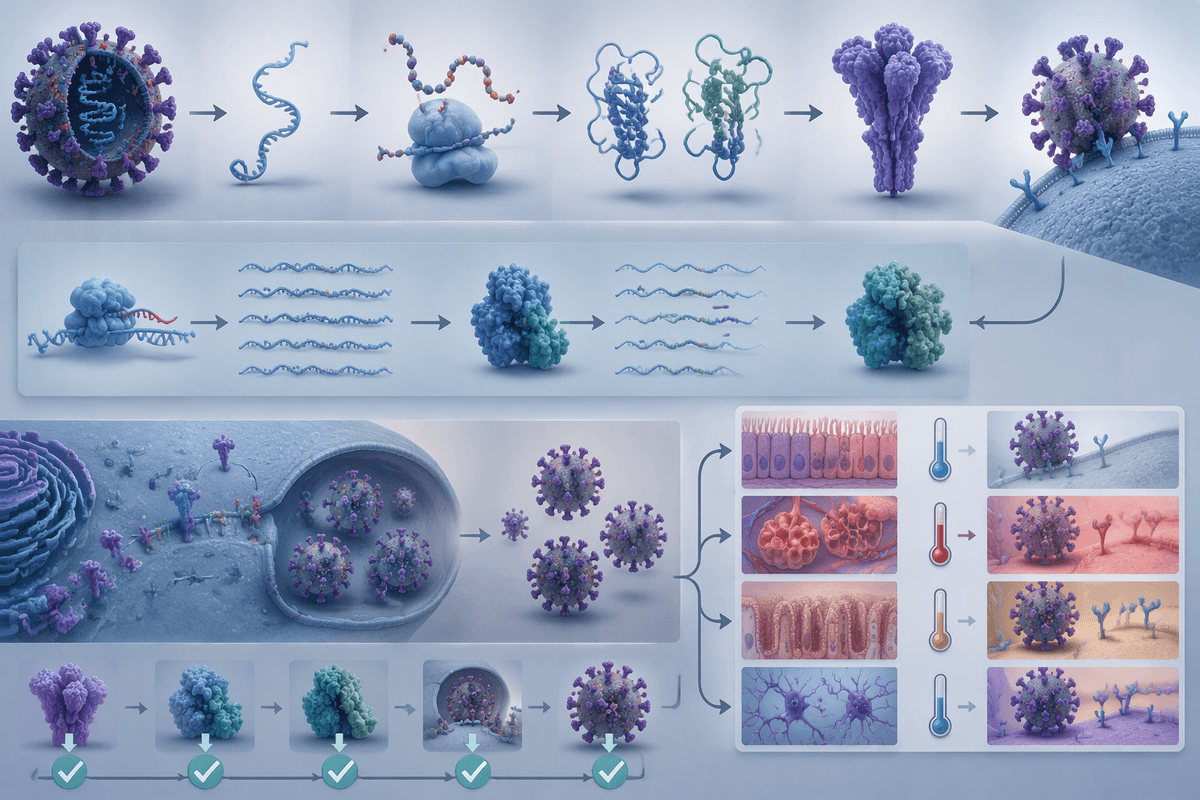
It’s tempting to treat “fitness” as a number you can read off a genome, but viruses earn fitness through a chain of real biological steps. A substitution that looks promising in a language-model score still has to fold into a working protein, survive the virus’s proofreading and packaging constraints, and function across tissues and temperatures. Many changes are only viable in the presence of other changes, so the unit of selection is often a whole combination, not a single mutation.
Fitness is also multi-dimensional. A variant can replicate faster in the upper airway yet transmit worse if it shortens infectious duration, or it can escape antibodies while paying a cost in receptor binding. Lab assays that optimize one endpoint (say, neutralization escape) can overstate real-world advantage when other bottlenecks dominate, including within-host competition and stochastic “founder” events. Getting beyond sequence scores usually means integrating functional assays, structural constraints, and growth measurements—work that is slower, more expensive, and harder to scale than sequencing.
Environment and behavior: selection pressures move the goalposts
A familiar frustration in surveillance teams is watching a “high-risk” mutation linger at low levels for months, then suddenly take off—or disappear after a brief spike. The difference is often not the genome itself but the moving backdrop it competes in. A variant that wins in a largely naïve population may lose once immunity becomes widespread; a change that helps evade antibodies can matter less when transmission shifts toward groups with low vaccination uptake, or when boosting campaigns reset the immune landscape. Even weather and school calendars can tilt the advantage toward variants that spread better in certain settings, regardless of their within-host replication edge.
Behavior and policy changes also rewrite selection pressures on short notice. Masking, ventilation, testing access, and travel can change which transmission routes dominate and how many “rolls of the dice” the virus gets to explore mutations. Treatments add another layer: antiviral use can select for resistance in specific patient groups without making that resistance broadly advantageous. These forces are hard to measure cleanly and often lag in reporting, so models trained on sequences alone can look stable while the target they’re scoring against keeps shifting.
From black-box predictions to testable, useful forecasts
In the real world, a “prediction” only helps if you can act on it, and that usually means turning a model’s score into a claim you can test. Instead of “this lineage will dominate,” ask for a conditional forecast: in populations with recent booster coverage X and prior infection mix Y, variants with these spike changes should grow at rate Z relative to contemporaries, within a stated window and uncertainty. That reframing forces the model to reveal what it thinks the advantage is (escape, binding, replication, duration) and where it expects that advantage to matter.
The practical shift is to treat sequence models as hypothesis generators, not oracles. Use them to shortlist plausible mutation sets, then run targeted checks: structural sanity, known epistasis constraints, and a small panel of functional assays that match the decision—neutralization for vaccine updates, replication and shedding proxies for transmission risk, resistance assays where antivirals are common. This is slower and more expensive than scoring genomes in bulk, and it depends on labs that can standardize protocols, but it produces forecasts you can falsify, calibrate, and improve.
A workable playbook: hybrid models and disciplined iteration
A workable playbook looks less like a single “best” model and more like a pipeline that forces agreement between data, biology, and decision needs. Use sequence models to propose candidate mutation bundles, but gate them through constraints (protein stability, known epistasis, lineage background), then update their priors with whatever context you can measure: serology snapshots, treatment uptake, and where transmission is actually occurring. Treat forecasts as rolling bets with calibration checks, not one-off headlines. The hard part is operational: metadata is messy, assays have lead times, and teams must choose a small, repeatable test panel that matches the policy lever.