When “bad creative” is really a decision problem
You’ve seen it: a concept that felt strong in the room becomes a safe, generic execution by launch. The easy diagnosis is “bad taste” or “not enough talent,” but most of the time the work is reflecting a series of small decisions made under real constraints. Someone chose speed over exploration. Someone optimized for the loudest stakeholder’s preferences. Someone accepted unclear success criteria because the deadline was immovable.
“Bad creative” often means the team kept making locally reasonable choices that added up to a weak outcome. If you can name the decisions—what got prioritized, what got cut, who had the final call—you can improve the work without needing a miracle idea, or a different team.
Spot the pattern: what kind of poor decision happened?

A familiar moment: you’re reviewing work and you can feel something is off, but the notes stay vague. Start by labeling the kind of decision that produced it. Was it a goal problem (the team never agreed what “good” looked like), a trade-off problem (clarity got sacrificed for novelty, or vice versa), or a selection problem (the safest option won because it was easiest to defend)? Sometimes it’s a framing problem: the brief asked for “premium” and people interpreted it as “minimal” because no examples or boundaries were provided.
Other patterns show up in how choices were made: a single voice dominated, feedback arrived too late to change direction, or exploration was cut to protect a date. The constraint is real—time, budget, and attention are limited—so the useful move is identifying the decision type fast enough to adjust the next one.
The brief wasn’t wrong—it was incomplete or conflicted
A common failure mode is a brief that’s technically “right” but operationally unusable. It names a vibe (“bold,” “premium,” “human”) and a deliverable, but doesn’t specify what the work must accomplish, for whom, and in what context. Without a clear outcome metric—sign-ups, trial starts, time-on-page, recall, qualified leads—teams end up optimizing for what’s easiest to evaluate in a meeting: polish, familiarity, and stakeholder comfort.
The other trap is conflict hiding in plain sight. The brief asks for “distinctive” and “low risk,” “brand building” and “direct response,” “simple” and “feature-complete.” Those aren’t impossible, but they force trade-offs that someone has to own. If decision rights aren’t explicit, the work becomes a negotiation artifact: every round adds constraints, removes edge, and increases cost through rework. A fast check is to rewrite the brief as “We are willing to sacrifice X to protect Y,” and see who flinches.
Bias and emotion: how people decide under pressure
Quality often slips when a room gets tense. Under pressure, people rarely become completely irrational; they tend to protect themselves by choosing familiar options, reducing variables, and favoring decisions that are easy to defend. Loss aversion might sound like, “Let’s not risk confusing anyone,” even when the strategy needs some friction. Authority bias can turn a senior person’s casual preference into an unofficial requirement, while recency bias gives extra weight to the competitor campaign everyone saw that week. Exhaustion adds another problem: polished, easy-to-explain ideas start to feel more effective simply because they require less mental effort.
Emotion also shapes the way feedback is interpreted. A sharp comment early in a review can set the tone, making later evidence easier to dismiss. Public criticism raises the pressure to save face, so people defend their draft instead of testing another approach. The result is predictable: fewer experiments, more revision rounds, and decisions shaped more by internal comfort than by the response they are meant to create.
Process gaps that quietly manufacture bad options
You can do everything “right” in taste and still end up with bad options if the process keeps shrinking the decision space. A classic pattern is skipping divergence: the team goes from one rough concept to one polished route because production needs a file, not because the idea won. Another is missing checkpoints. Without an early alignment review (what success looks like, what risks are acceptable, what must be true), you discover misalignment only after the work has enough craft invested that changing direction feels expensive.
Feedback mechanics matter, too. When notes arrive as a long comment thread, each person optimizes for their own objection, and the draft becomes a patchwork. When the team never runs a clean comparison—two or three options judged against the same criteria—the “winner” is usually the one with the least controversy, not the strongest strategy fit. The constraint is real: adding rounds costs time and money. The fix is choosing fewer, better-timed moments to decide, and making those decisions explicit.
Misaligned constraints: time, budget, tools, and skills
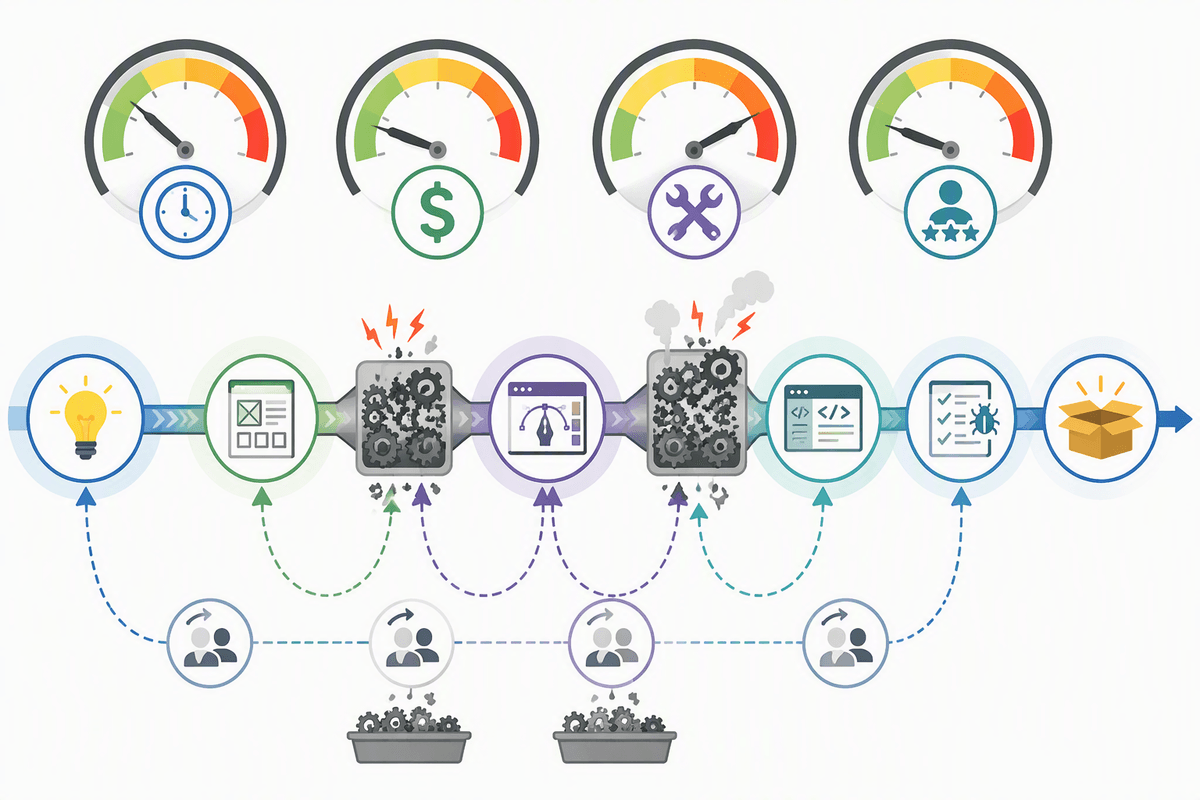
You can feel misaligned constraints when the plan assumes “high-craft” output but the inputs only support “good enough.” A three-day timeline with a brand-new message forces templates and familiar patterns, even if the strategy calls for surprise. A low budget with a high volume of deliverables quietly rewards reuse, not originality. And when tools don’t match the ask—no analytics access for performance work, no proper versioning for collaborative design—teams spend energy managing friction instead of improving the idea.
Skill mismatches create the same drag. Asking a generalist to produce motion design at launch quality, or a designer to write conversion copy, turns the project into on-the-job training under deadline. The cost shows up as extra rounds, brittle files, and decisions made to avoid technical risk (“Can we do it?”) rather than audience impact (“Should we do it?”). A useful check is to list what the concept requires (time, money, capabilities) and decide what you’ll simplify before production starts.
Fixes that address multiple causes at once
The “single fix” approach rarely holds. Tightening the brief, adding another brainstorm, or scheduling one more review may improve one weak spot while leaving the rest of the decision process untouched. Stronger systems change how decisions get made. Start with a one-page decision brief covering the main goal, the audience context, three non-negotiables, and one deliberate trade-off, such as choosing clarity over breadth or speed over novelty. Put decision rights in writing as well: who sets direction, who owns the craft, who gives input, and what qualifies as evidence.
Critique works better when the discussion centers on comparisons rather than instinct. Bring two or three options to an early review, judge each against the same criteria, and record the reasoning in plain language. That gives later feedback something solid to build on instead of letting every new opinion rewrite the rationale. Keep the notes focused on two major risks and one question that can be tested. The extra setup takes time, especially when deadlines are tight, but earlier decisions are usually cheaper than late-stage rework.
Feasibility belongs in the conversation before constraints turn into excuses. Check the timeline, budget, available tools, and missing skills early enough to simplify deliberately rather than slowly weakening the work through negotiation. With clear priorities, visible trade-offs, and defined ownership, creative judgment still matters, but it no longer has to carry the entire process.
A practical takeaway: treat creativity like a system
You’ll make better creative calls when you stop treating “good taste” as the control knob and start treating the work like a system with inputs, constraints, and decision points. Before you chase a stronger idea, check the basics: is success defined in a way you can measure, are trade-offs named, and does the team know who decides what? Then protect a small set of repeatable habits—early comparisons, a written rationale, and a critique loop that produces choices, not comments.
This won’t eliminate weak work, because time, budgets, and stakeholder politics are still real costs. It does make failure diagnosable and fixable: if the output is bland, you can point to the missing input or broken step, not the person who happened to be holding the pen.