AI trading worries: why this question keeps coming up
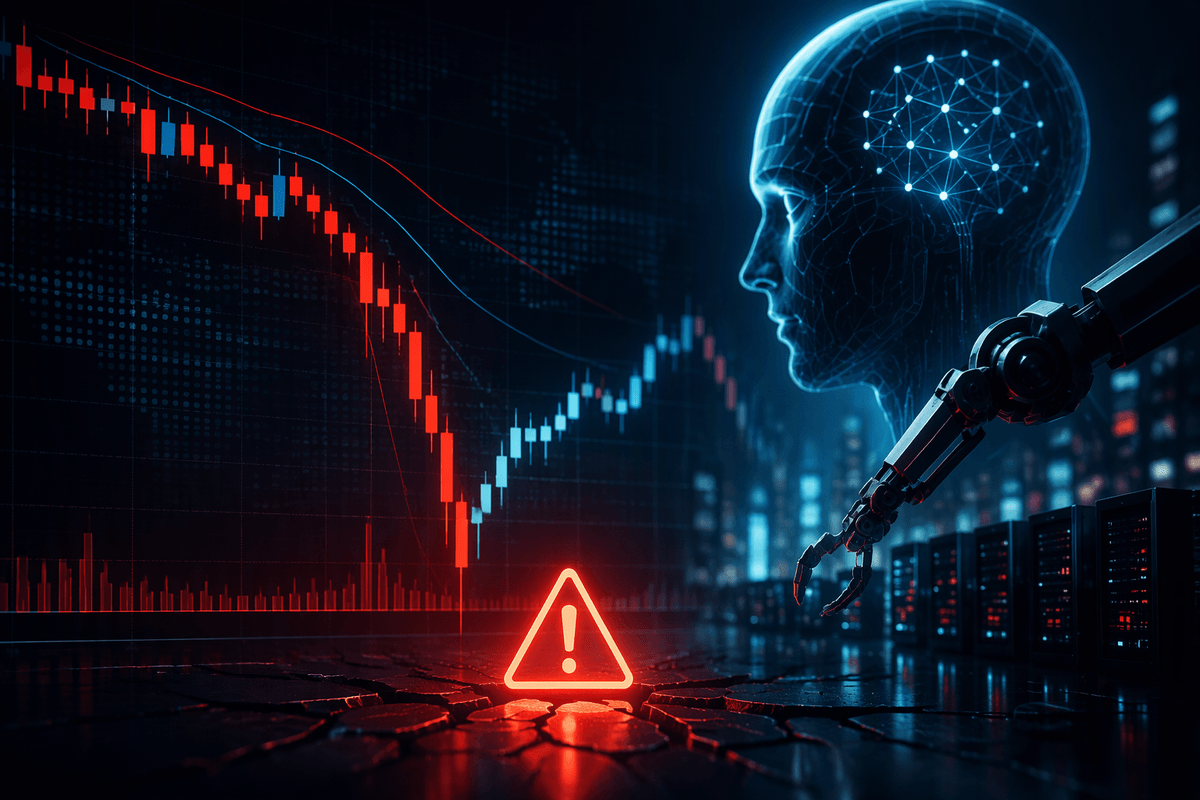
You see a sudden intraday drop, a chart that looks like a cliff, and then a quick rebound. Even if your long-term view hasn’t changed, it’s natural to ask whether “the machines” are pushing prices around. That worry keeps resurfacing because markets now react in milliseconds, headlines travel instantly, and more decision-making is delegated to automated systems that can act faster than any human desk.
The specific fear isn’t that AI “predicts” the market perfectly. It’s that many fast strategies can read the same signals, place similar trades, and reinforce each other’s moves. When liquidity thins—around news, at the open, or during stress—small imbalances can travel further than you’d expect. The cost of speed also matters: complex models can fail in simple ways when data shifts, feeds glitch, or everyone tries to exit at once.
What counts as “AI” in automated trading today?
If you ask ten people what “AI trading” means, you’ll get everything from a simple rule like “sell if it breaks support” to fully automated systems that digest news, order books, and alternative data. In practice, most of what moves fastest today still looks like classic automation: algorithms that slice big orders, market-making systems that constantly quote, and high-frequency strategies that react to micro-changes in price and liquidity. Those may use statistics and optimization, but not necessarily modern machine learning.
Where “AI” is more literal is in model-driven signal generation and forecasting—systems trained on large datasets to predict short-horizon returns, volatility, or order-flow patterns. Some firms also use language models to classify headlines or parse filings, then feed those scores into execution. The important distinction is autonomy: the more a model can change behavior without a human explicitly rewriting rules, the more you have to worry about edge cases, hidden correlations, and how it behaves when conditions look unlike the training data.
How automation can turn noise into momentum
Picture a quiet morning where a single headline is ambiguous, or a few large orders hit at once. A human might pause, check context, and decide it’s not meaningful. Automated systems often can’t afford that pause. They respond to the first measurable change—spread widening, quotes disappearing, a burst of sell orders—because their job is to manage risk in real time.
That’s how “noise” becomes momentum. If market makers detect higher short-term risk, they may widen spreads or pull back size. That makes it easier for the next sell order to move the price, which triggers more stop-losses, volatility-targeting funds reducing exposure, and trend-following signals turning negative. None of these actors needs to be “wrong” for the loop to bite; each is following a rule that is locally reasonable.
When everyone tries to trade the same direction at the same time, the market’s ability to absorb orders collapses. Speed can then compress what would have been an hour of messy repricing into seconds, leaving slower investors staring at prints that don’t reflect stable two-way markets.
Flash crashes and micro-panics: lessons from history
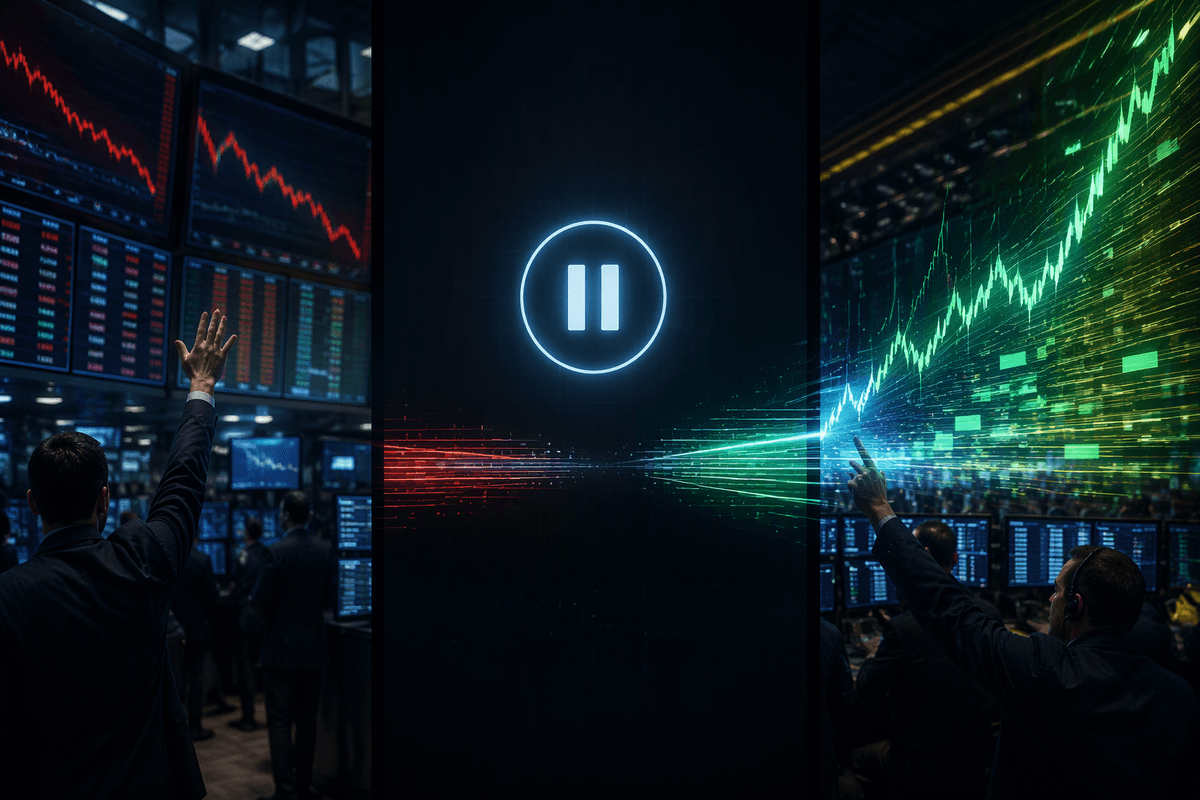
You’ve already seen the pattern in real incidents: prices drop sharply, liquidity vanishes, and then things snap back once orders reappear. The classic example is the May 6, 2010 “Flash Crash,” where a fast selloff in U.S. equities briefly cascaded across venues as automated strategies reacted to each other under thinning liquidity. Smaller “micro-panics” have shown up since then too—often tied to a sudden spike in volatility, a data-feed issue, or a rapid shift in order-book depth rather than a new fundamental fact.
The historical lesson is less about one villain algorithm and more about fragile market plumbing. When many systems share similar risk triggers—pull quotes, cut inventory, or hit bids when momentum turns—ordinary safety behavior can synchronize. Stabilizers exist, like limit up/limit down bands and exchange circuit breakers, but they’re not free: pauses can concentrate order flow, and the rebound can be just as mechanical as the drop.
What AI changes compared with classic quant trading
A familiar shift is that some newer models don’t just follow hand-written “if X then Y” logic; they learn patterns from data and can behave differently as inputs drift. Classic quant signals are often easier to interpret and constrain: you can usually point to a factor, a threshold, a risk budget, and a reason it should stop trading. With machine-learned signals, the boundary between “signal” and “noise” can move without anyone noticing until the strategy is already leaning harder into the same trade as its peers.
AI also changes the correlation problem. Many teams train on similar datasets, optimize for similar objectives, and use the same market features (short-term momentum, order-flow imbalance, volatility). That can make crowding less visible: the codebases look different, but the trades rhyme. Add the practical reality that models can fail in boring ways—stale data, regime shifts, overfitting—and you get a setup where exits synchronize. The cost is ongoing monitoring, retraining discipline, and tighter controls that can reduce returns in calm markets.
Where the real fault lines are: incentives and constraints

Think about the simplest desk-level incentive: don’t be the one holding risk when the tape starts to look strange. A market maker that keeps quoting through a volatility spike can get “run over,” so its safest move is to widen spreads or step back. A trend or volatility-controlled fund is rewarded for steady risk, so it sells when volatility rises, regardless of whether the original move was meaningful. Add performance pressure and tight drawdown limits, and lots of systems end up with similar “get smaller, fast” behavior that can line up at the worst moment.
Latency and transaction costs punish constant churn, so not every model can flip instantly. Inventory limits, kill switches, and pre-trade checks cap how aggressive an automated strategy can be. Exchanges also impose market-wide brakes like limit up/limit down and circuit breakers. The practical gap is that many of these controls are local. They protect one firm or one venue, but they don’t guarantee liquidity stays available across products when everyone tries to de-risk at once.
Guardrails that reduce the chance of a spiral
Watch what actually happens when markets start to gap: many systems don’t “double down,” they back away. That’s partly fear, but it’s also engineering. Most serious automated desks run layered limits that trip long before a strategy can lever itself into a runaway loop—maximum order rates, position and notional caps, price collars, and automated “kill switches” that shut off trading if fills, slippage, or data quality look abnormal. Those controls are paired with basic hygiene like redundant market data, heartbeat checks to detect stale feeds, and rules that fall back to simpler behavior when model inputs go out of bounds.
Market structure adds a second layer. Limit up/limit down bands prevent prints far from recent prices, and exchange-wide circuit breakers force a pause when moves get extreme. In calmer moments, minimum tick sizes, maker-taker fees, and quoting obligations in some venues can make it less attractive to yank liquidity instantly. None of this is free: tight limits can reduce profitability and widen spreads in normal markets, and a well-timed pause can also concentrate a backlog of orders that hits all at once when trading resumes.
The practical guardrail is diversity of constraints, not a single magic brake. When firms, venues, and regulators rely on different triggers and time horizons, it’s harder for one feedback loop to propagate cleanly across the whole system.
So could AI destabilize markets? A balanced takeaway
Most of the time, AI doesn’t destabilize markets by “taking control,” but by compressing ordinary behaviors—risk cutting, spread widening, stop and trend signals—into a tighter window where liquidity can’t keep up. The realistic failure mode is a fast, correlated retreat from providing liquidity, not a single rogue model placing absurd orders.
The counterweight is that modern markets are built around brakes and limits, and serious firms are heavily constrained by pre-trade checks, inventory caps, and shutdown controls. That reduces the odds of a system-wide spiral, but it doesn’t erase it. As an investor, treat sudden depth loss, widening spreads, and cross-asset wobble as the tell, and assume “instant exits” cost more than backtests imply.