Why AI shows up in nearly every course
You can feel AI everywhere on campus even when a syllabus never mentions it. Classmates use it to outline readings, generate practice questions, debug code, or polish drafts, and that changes the baseline pace of a course. Instructors respond in different ways: some build AI into assignments to make expectations explicit, some tighten rules, and some redesign tasks toward in-class work or process evidence.
AI also shows up because it is now part of the tools students already carry into coursework, like search, spellcheck, and citation managers—just more powerful and more ambiguous. Schools want graduates who can use modern workflows, but they also have to protect assessment. That tension is why policies, disclosures, and “allowed uses” pages keep multiplying, even when the guidance still feels incomplete.
Where AI genuinely helps you learn faster
AI is most useful during those moments when the main idea makes sense but a particular step still feels unclear. It can offer a different explanation, walk through a comparable example, or turn class notes into focused practice questions. When feedback is limited, it also provides another way to review your work, using a grading rubric to identify weaknesses or generating counterarguments to test an idea before it becomes part of a finished draft.
The greatest benefit comes from treating AI as a tutor rather than an answer key. Ask it to show two methods, explain why a step is valid, identify what a grader might question, or quiz you until you can solve the problem independently. Checking the reasoning, verifying sources, and reorganizing the explanation in your own words takes extra effort, but those steps help turn a quick answer into lasting understanding.
The hidden costs: skills you can quietly lose

You recognize the hidden costs when your work looks “finished” faster than your understanding improves. If AI always supplies the first outline, the clean phrasing, or the next algebraic step, you get fewer reps at the uncomfortable parts that build skill: choosing what matters, holding a claim in your head while you test it, and pushing through confusion without someone patching the gap. Over time, students often become good at supervising outputs but weaker at generating their own.
Writing is the clearest example. If you outsource sentence-level decisions, you quietly lose voice, precision, and the ability to revise from a messy draft into a coherent argument. Similar erosion shows up in reading (skimming summaries instead of tracking an author’s logic), coding (accepting working code without understanding the failure mode), and quantitative work (following steps without recognizing when an assumption is broken). AI saves time now, but it can increase future time spent relearning fundamentals when exams, interviews, or upper-division courses demand unaided performance.
Accuracy, hallucinations, and the research trap
AI-generated answers may sound well researched even when the evidence behind them is weak or nonexistent. Models sometimes state false claims confidently, combine details from similar studies, or produce citations that look credible but do not exist. Even when the main point is accurate, the supporting evidence may be misrepresented: survey findings presented as experimental results, correlations described as causes, or an isolated paper treated as scientific consensus. These errors matter in academic work, where grades depend on the evidence supporting an argument, not simply on how convincingly it is written.
A more reliable approach is to use AI to develop questions and possible explanations, then verify them independently. Ask for useful search terms, competing interpretations, and the kinds of evidence that would distinguish between them. Check the results against course materials and established research databases, confirming the authors, publication venue, date, and whether the cited passage actually supports the claim. Verification takes extra time and may feel repetitive, but it separates genuine research from text that merely sounds scholarly.
Academic integrity: rules, disclosure, and gray areas
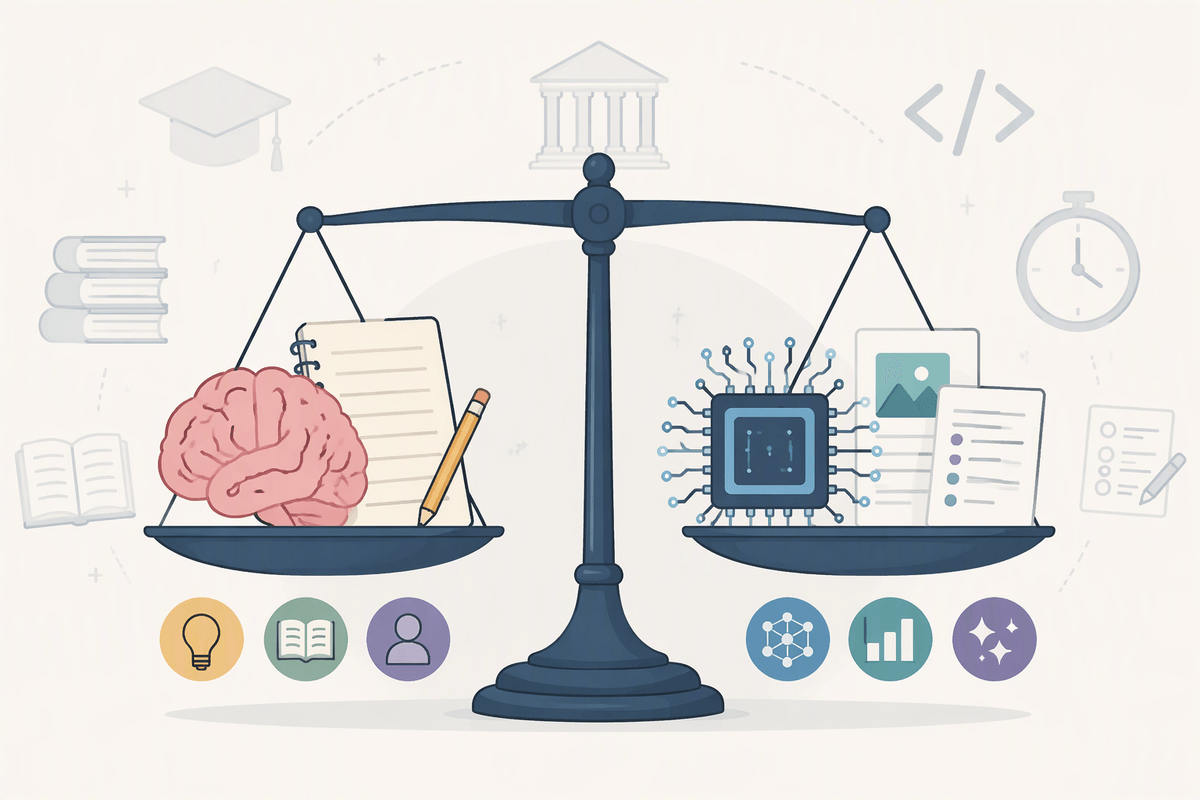
You notice integrity issues most when an assignment is meant to measure process, not just a final product. If the learning goal is “can you draft an argument,” “can you solve under exam-like constraints,” or “can you implement this algorithm,” then having AI generate large chunks can function like unauthorized help even if the result is technically “your” submission. The problem is that course rules vary widely: some instructors allow brainstorming and editing but not generation, others require disclosure of any use, and others treat AI like outside tutoring with strict limits.
Gray areas show up in small choices: Is rewriting your paragraph for clarity the same as grammar correction? If AI suggests a theorem or a code pattern, is that a reference you should cite? If it produces a bibliography entry, are you responsible for verifying it line by line? A practical default is conservative: keep a brief log of what you asked and what you used, disclose when in doubt, and never submit text, proofs, or code you could not reproduce and explain without the tool. The real cost is time and humility, but it is cheaper than a misconduct case.
Privacy, equity, and who pays the price
Even a quick prompt may leave a lasting record of drafts, lab notes, patient vignettes, interview transcripts, or code from a private repository. Submitting this material to a third-party system may create copies outside your control, subject to terms and data-retention practices that are not always easy to verify. The risk is especially relevant in group projects, internships, and research labs, where information may belong to other people or involve unpublished work. Protecting that material may require removing identifying details, using institution-approved tools, or avoiding AI for sensitive tasks altogether, even when those options are less convenient.
Access to AI tools also varies with students’ financial circumstances. More capable models, advanced coding assistants, and multimodal features may require paid subscriptions, giving students with greater resources an advantage in completing assignments efficiently. Campus licenses may help, but they do not eliminate differences in device quality, internet access, disability accommodations, or the ability to use AI safely at home or work. Access to reliable, policy-compliant tools is becoming another factor in students’ ability to keep up, alongside their knowledge and academic skills.
A practical way to use AI without outsourcing learning
You can treat AI like “training wheels,” not a replacement engine, by tying it to checkpoints you must pass unaided. Start by attempting the task for 10–15 minutes: outline from the readings, sketch the proof idea, write the ugly first paragraph, or draft the function without autocomplete. Then use AI only to critique your attempt: ask for missing steps, alternative structures, edge cases, or likely rubric deductions, and force it to explain its suggestions in course terms.
Finish with a no-AI replication step: rewrite the argument from memory, re-solve a similar problem, or implement again from a blank file. If you can’t do that, you used it too early. Keep a brief usage log and follow the strictest course rule you can find; the extra time is the cost of keeping the skill.