Why Great Lakes levels are hard to predict
Anyone who works near the Great Lakes has seen the mismatch between what feels “normal” and what actually happens: docks that were fine last year sit too high or too low this year, and a few weeks of weather can shift conditions enough to change access, erosion risk, or dredging needs. The difficulty is that lake levels respond to several moving parts at once—precipitation, runoff from a huge basin, evaporation driven by air temperature and wind, and outflows that are partly managed and partly constrained by channels.
Those drivers also operate on different clocks. A single storm can spike inflows locally, but the seasonal buildup and drawdown depends on cumulative moisture, heat, and wind over months. Winter adds another wrinkle: ice changes how evaporation and wave action behave, and it can distort some observations. Even with good data, forecasts face practical limits: some inputs (like future wind fields) are uncertain, and small errors can compound when you’re trying to look weeks to months ahead.
What actually drives water levels day to season
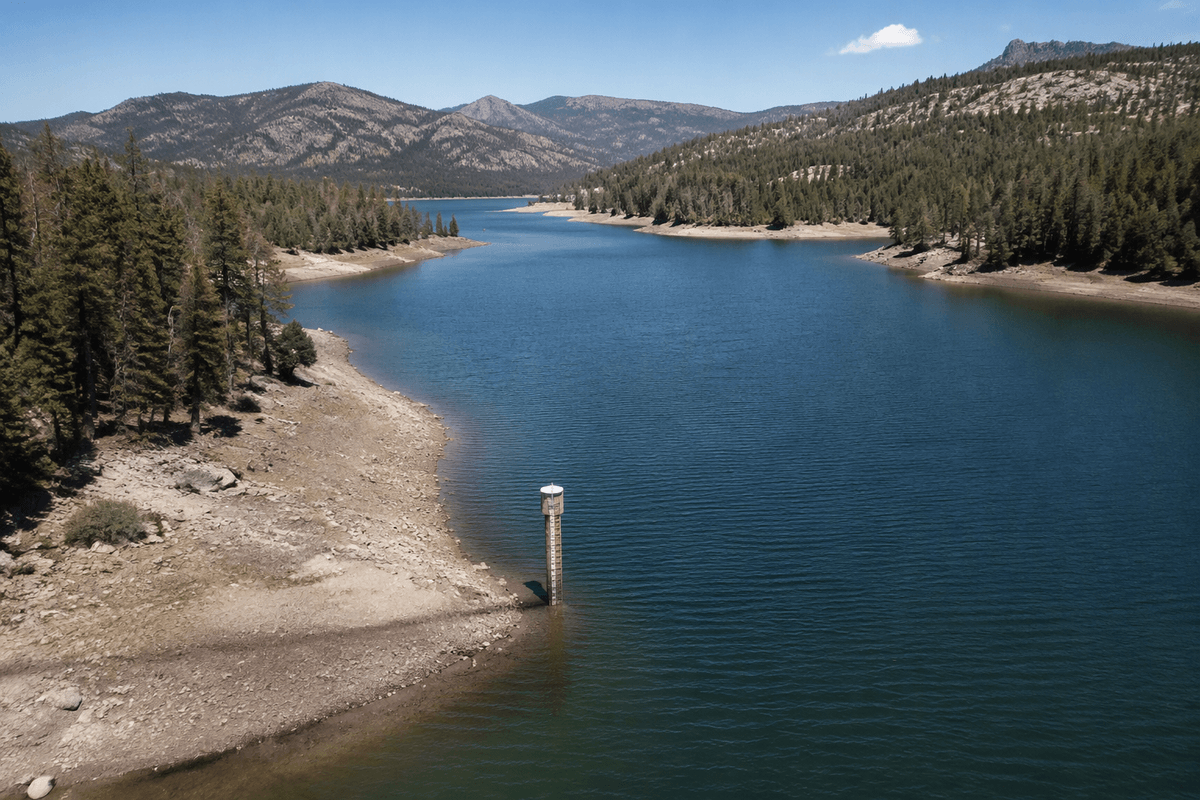
If you check a lake gauge every day, the first thing you notice is that “water level” is a mix of two motions. One is the basin-wide level set by net water supply: precipitation onto the lake, runoff from the watershed, groundwater exchanges, evaporation from the lake surface, and any diversions or connecting-channel flows. That part changes over days to seasons, and it’s where most planning decisions live.
The other motion is short-lived setup and seiche—wind piling water up on one shore and pulling it down on the other, sometimes swinging back and forth for hours. A marina can see big swings without the lake’s total water storage changing much. For day-ahead operations, wind direction, sustained speed, and storm track matter as much as rainfall totals.
Seasonally, evaporation often dominates the drawdown, and it’s tightly linked to water temperature, air temperature, humidity, and ice cover. These are exactly the variables that weather models struggle with most during rapid pattern shifts, so “AI accuracy” is often limited by forecastable physics, not the algorithm.
Choosing data sources and building usable features
Great Lakes level forecasts can suffer when models rely on whatever data is easiest to obtain, such as readings from a single gauge or weather station. Water levels respond to conditions across the wider basin, so reliable forecasts depend on broad, consistent coverage. Three groups of inputs are particularly important: observed water levels from multiple gauges, along with connecting-channel flows where relevant; meteorological measurements across the basin and lake surface, including precipitation, wind, humidity, and air temperature; and indicators of the system’s longer-term state, such as lake surface temperature, snow water equivalent, and ice cover. Reanalysis datasets help fill gaps and maintain consistent spatial coverage, but their smoothing can obscure extreme conditions that matter for risk assessment.
Feature engineering must reflect how the lakes respond to changing conditions over time. Useful inputs include precipitation averaged across relevant sub-watersheds, accumulated moisture over periods of 7 to 60 days, and degree-day measures that help represent conditions associated with evaporation. Lagged variables allow the model to capture delayed effects, such as rainfall contributing to runoff days or weeks later. Short-term water-level forecasts can also benefit from wind setup features that account for shoreline orientation and the distance wind travels across open water.
Data quality requires particular care before modeling begins. Inconsistent timestamps, changes in measurement datums, missing observations, sensor behavior during ice cover, and relocated stations can all introduce errors that are difficult to distinguish from genuine changes in lake conditions. Standardizing these records and documenting their limitations helps prevent data inconsistencies from undermining the forecasting model.
Start with baselines before reaching for deep learning
A common pattern is jumping straight to an LSTM or transformer because the lake is “complex,” then discovering the model mostly learns the seasonal cycle you could have captured with simpler tools. Start with baselines that are easy to explain and hard to beat: a persistence forecast (tomorrow looks like today), a seasonal climatology curve by day-of-year, and a linear regression or ARIMA-style model using a few well-chosen lags and cumulative precipitation/heat terms. These establish how much skill you’re getting beyond “normal behavior,” and they expose whether your features actually add signal.
Baselines also reveal practical constraints before you invest months of effort. If errors spike every ice season or during wind-driven setups, deep learning won’t fix missing physics or noisy inputs. It may even overfit rare extremes unless you have enough historical events and clean, consistent training data—which is often the real cost in Great Lakes work.
Picking an AI model that fits your forecast task
The shoreline planner asking “Where will the monthly mean be?” is solving a different problem than a port operator asking “Will the next 18 hours put water over the sill?” For short horizons (hours to a few days), models that combine weather-forecast inputs with flexible nonlinear learners can help: gradient-boosted trees often work well with engineered wind, pressure, and recent-level-change features, and they stay relatively interpretable when you need to explain why a warning was triggered. For multi-week to seasonal outlooks, sequence models like LSTMs can add skill when the training set is long and consistent, but they are easy to fool into learning the calendar instead of the water balance unless you force them to use meteorology, temperature, ice, and runoff proxies.
Hybrid setups are usually the practical middle ground: a simple water-balance baseline plus a machine-learning residual model that learns what the baseline misses. You must run the same feature pipeline every day, handle late or revised inputs, and accept that ice seasons and extreme storms may still require conservative buffers because they are underrepresented in the data.
Validation, uncertainty, and the seasonal traps
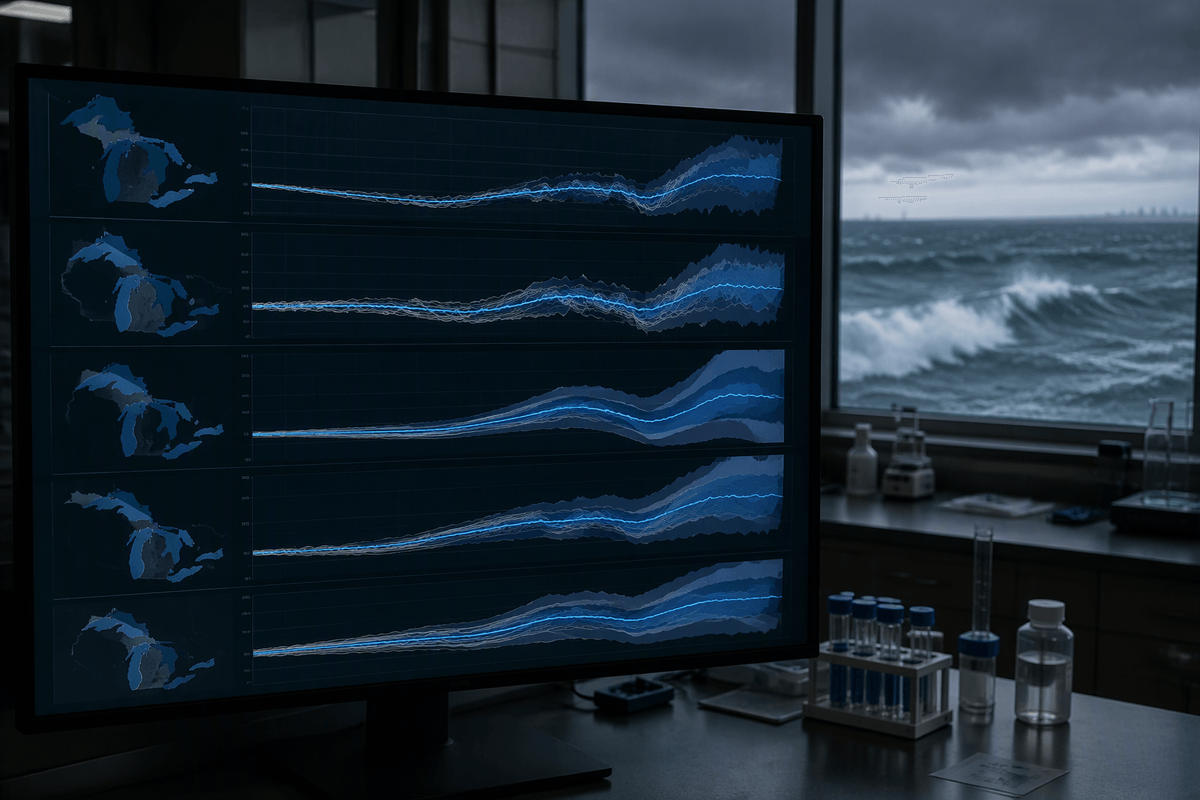
Low error on a plot does not necessarily mean a model has learned how Great Lakes water levels evolve. It may simply have learned to recognize the time of year. Strong seasonal patterns make random train/test splits vulnerable to data leakage: when observations from different Julys appear in both sets, the model can learn typical summer behavior without demonstrating that it will generalize to future conditions. A more realistic evaluation trains on earlier years and tests on later ones, with additional checks during periods of rapid change, such as spring rises and late-autumn fluctuations driven by wind and evaporation. Performance should be compared with appropriate baseline models, using more than RMSE alone. Results also need to show whether forecasting improves during difficult months, rather than only during relatively predictable periods.
Point forecasts tell only part of the story when decisions carry different consequences. A marina may tolerate a false alarm, whereas an inaccurate estimate could disrupt a dredging plan or lead to costly mistakes in a shoreline project. Prediction intervals from quantile models, ensembles, or bootstrapped residuals help represent the range of plausible outcomes. Their reliability needs regular checking: a nominal 90% prediction interval should contain the observed water level in roughly 90% of cases over time. Uncertainty is likely to widen during ice seasons, extreme storms, and shifts in underlying conditions. These periods also tend to bring poorer input data and fewer historical examples, limiting how much modeling can reduce uncertainty.
Turning forecasts into decisions and keeping them reliable
A forecast becomes useful when it is tied to a threshold you actually operate around: “will the water be within 0.2 m of the dock freeboard,” “will we need to delay a launch,” or “will setup push levels above the revetment crest.” Use the full predictive distribution, not a single number: trigger actions when the probability of crossing a threshold is high enough to justify the cost of acting, and keep conservative buffers for ice season and fast-moving storms.
Reliability comes from treating the model like an instrument that drifts. Monitor error and interval calibration monthly, watch for bias changes after sensor updates or channel-management shifts, and retrain on a schedule with a held-out “future” test period. When inputs are late or revised, fall back to a simpler baseline rather than silently extrapolating.